Eukaryotic organisms have evolved a highly specialized molecular surveillance system that limits the activity of foreign genetic material through a regulated RNA degradation and turnover pathway known as RNA silencing. This mechanism is exceptionally efficient because once it is triggered by abnormal, foreign, or structurally atypical RNA molecules, it establishes a sequence-based targeting system that can recognize and repress any RNA species present in the cytoplasm that shares sequence complementarity with the original trigger. In this way, RNA silencing functions not merely as a regulatory gene-expression process but as a nucleic-acid–level immune defense system.
The concept of RNA silencing first emerged from experimental work in transgenic plants, particularly petunia, where the introduction of foreign transgenes unexpectedly led to a coordinated suppression of both the introduced sequences and endogenous genes with homologous regions. This phenomenon revealed that gene expression could be downregulated through RNA-mediated mechanisms rather than classical transcriptional control. Subsequent research demonstrated an even more striking property: even transgenes lacking direct sequence homology with the host genome could still activate silencing pathways, acting as both triggers and targets under certain conditions.
Beyond plants, similar RNA-based regulatory and defensive processes were identified in animals, including early-stage mouse embryos, where experimentally introduced double-stranded RNA (dsRNA) was shown to activate a potent gene-silencing response known as RNA interference (RNAi). Over time, it became clear that RNA silencing is not a plant-specific phenomenon but a deeply conserved biological system operating across evolutionary kingdoms. Genetic and biochemical analyses in organisms such as Caenorhabditis elegans, Drosophila melanogaster, Neurospora, Chlamydomonas, and Arabidopsis have reinforced the idea that the core machinery of RNA silencing is ancient and widely preserved.
In animals, one of the naturally established roles of RNA silencing is the suppression and genomic control of transposable elements, preventing their uncontrolled mobilization within the genome. In higher plants, however, the system has taken on an additional and highly significant function: antiviral defense. Since the majority of plant viruses possess RNA genomes with high replication rates, the RNA-based recognition, amplification capacity, and trans-acting behavior of RNA silencing make it particularly suited to combat viral invasion effectively.
A prevailing model suggests that nuclear-encoded transgenes are frequently interpreted by plant cells as viral-like RNA entities, thereby activating the silencing machinery as if responding to infection. As research progressed, a clearer mechanistic framework began to emerge, linking RNA silencing not only to gene regulation but also to broad-spectrum antiviral immunity in plants.
A Generalized Defense Response to Viral Infection
For many decades, plant virology has exploited a phenomenon known as cross-protection, in which prior infection with a weakened viral strain can reduce or prevent subsequent infection by closely related viral variants. This strategy resembles a primitive form of vaccination and is based on the observation that an initial viral infection can suppress the accumulation of a secondary, genetically similar virus.
Further investigation revealed that cross-protection is not simply a physiological interference effect but rather a sequence-specific RNA-mediated defense mechanism. The suppressive activity targets invading viral genomes through post-transcriptional processes that recognize nucleotide homology between viral RNA molecules.
Studies using potato virus X (PVX) as a model system demonstrated that this protective response is functionally equivalent to RNA silencing. It operates through a trans-acting mechanism capable of degrading single-stranded viral RNAs in a highly sequence-selective manner. This established a direct mechanistic link between classical plant viral resistance phenomena and RNA silencing pathways.
Earlier observations using modified viral vectors provided additional insight. When PVX constructs carrying fragments of plant genes infected host tissues, the resulting symptoms often mirrored genetic mutations of those endogenous genes. This occurred because the viral system induced a reduction in corresponding host mRNA levels. In these cases, the silencing response was not limited to viral RNA but also extended to host transcripts sharing sequence similarity with viral inserts, a phenomenon later termed virus-induced gene silencing (VIGS).
VIGS has since been observed across a wide range of virus–host systems, suggesting that RNA silencing represents a universal antiviral strategy in plants. Importantly, this response occurs early during infection, primarily in initially infected cells, thereby reducing viral replication at a critical stage before systemic spread.
One of the most remarkable features of this defense system is its adaptive specificity. Unlike classical immune systems that rely on genetically encoded recognition receptors, RNA silencing derives its specificity directly from the sequence of the invading genetic element itself. This means the system can, in principle, adapt to any virus without prior genetic preparation by the host.
Another crucial property is its ability to propagate systemically. The silencing signal can move between distant tissues through a mobile, sequence-specific signal, allowing the defense response to spread throughout the organism. This systemic signaling was first observed in transgenic plants and later confirmed as an integral component of natural antiviral responses.
Together, these properties adaptability, mobility, and sequence specificity define RNA silencing as a sophisticated immune-like system operating at the RNA level.
Viral Countermeasures: Suppression of RNA Silencing
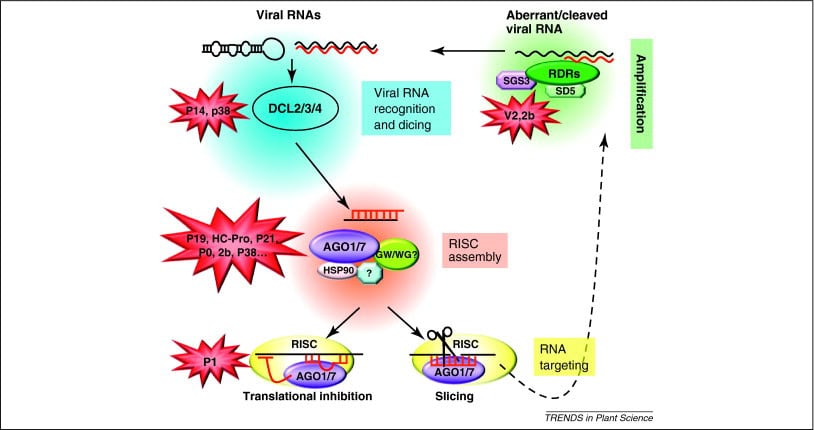
The existence of RNA silencing as a powerful antiviral mechanism implies that viruses must have evolved strategies to counteract or evade it. Indeed, many plant viruses encode specialized proteins that suppress different stages of the RNA silencing pathway.
A key discovery in this context was the identification of the potyviral HcPro protein, which was shown to dramatically enhance viral symptom severity when co-infecting plants with other viruses. This effect results from suppression of host defense mechanisms that normally limit viral accumulation. Experimental expression of HcPro alone was sufficient to inhibit both transgene-induced and virus-induced RNA silencing, confirming its role as a silencing suppressor.
Subsequent research identified additional viral suppressors across diverse virus families, including proteins such as 2b, P1, p19, and others from RNA and DNA viruses. These suppressors interfere with RNA silencing through different mechanisms, yet converge functionally on disabling host antiviral responses. The widespread occurrence of such proteins across plant viruses indicates that silencing suppression is a universal evolutionary strategy.
Interestingly, suppressor proteins show extreme diversity in both sequence and structure, suggesting that they evolved independently multiple times. Despite this diversity, they often converge functionally on similar targets within the host silencing machinery, a phenomenon consistent with evolutionary convergence driven by host–pathogen co-evolution.
Some suppressors also play direct roles in viral movement. Since systemic infection requires long-distance spread within the host, suppression of RNA silencing not only enhances viral replication but also facilitates viral transport between cells and tissues. In some cases, suppressors may interfere with the movement of the silencing signal itself, preventing the host from preemptively defending uninfected cells.
Mechanistic Basis of RNA Silencing in Antiviral Defense
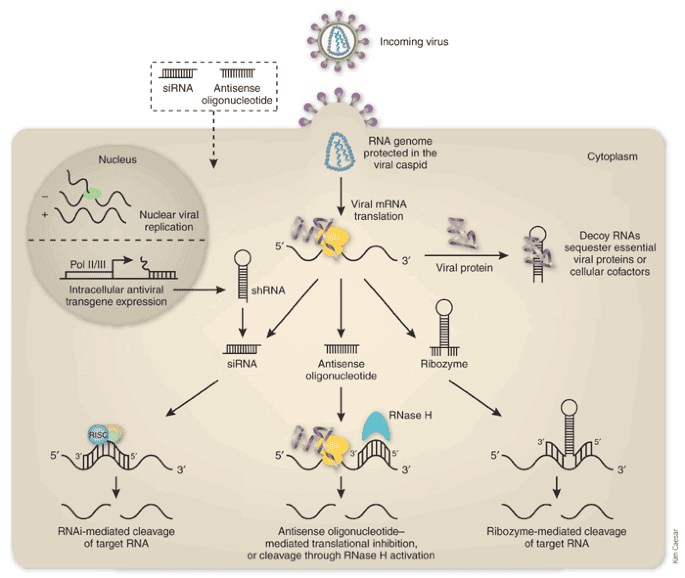
At the molecular level, RNA silencing is initiated primarily by the presence of double-stranded RNA (dsRNA). This molecule acts as a universal trigger because it is often produced during viral replication. Experimental evidence shows that dsRNA is significantly more effective at inducing silencing than single-stranded RNA, reinforcing its role as the primary activator of the pathway.
During RNA virus replication, dsRNA intermediates accumulate and serve as molecular signatures of infection. These molecules are recognized and processed into smaller RNA fragments approximately 21–23 nucleotides in length. These short RNAs then guide the silencing machinery to complementary RNA targets, leading to their degradation.
These small RNAs are now understood to be the specificity determinants of the RNA silencing system. They function as molecular guides that direct effector complexes to matching RNA sequences, ensuring precise targeting of viral transcripts.
The core mechanism of RNA silencing can be conceptually divided into three sequential steps:
- Processing of dsRNA into small 21–23 nucleotide RNA fragments
- Loading of these fragments into effector protein complexes
- Sequence-specific degradation of complementary single-stranded RNA
A key enzyme involved in the first step is Dicer, which cleaves dsRNA into small RNA duplexes. These products are then incorporated into the RNA-induced silencing complex (RISC), which executes the degradation of target RNAs.
This two-stage system provides an important biological advantage: a small amount of viral dsRNA can trigger a large-scale defensive response by generating numerous small RNA guides.
Systemic Signaling and Regulatory Complexity
RNA silencing is not confined to individual cells. Instead, it can spread systemically through the plant via a mobile signal that retains sequence specificity. This allows the immune response to propagate beyond the initial site of infection, effectively providing a whole-organism defense system.
In addition to antiviral defense, RNA silencing is deeply integrated into gene regulation and developmental control. Mutations in key components of the pathway often result in severe developmental defects, indicating that the same machinery used for antiviral defense is also essential for normal gene expression regulation.
Genetic studies have identified multiple host factors required for different stages of silencing, including RNA-dependent RNA polymerases and helicase-like proteins. Interestingly, many of these factors are necessary for silencing triggered by transgenes but appear less critical for direct viral infection, suggesting that viruses may bypass or compensate for certain host requirements through their own replication machinery.
Viral Suppressors and Their Diverse Mechanisms
Different viral suppressors act at distinct points in the silencing pathway. Some interfere with early dsRNA processing, while others disrupt downstream steps such as small RNA accumulation or systemic signal propagation. For example, certain suppressors eliminate the production of 21–23 nucleotide RNAs, while others specifically block the spread of silencing signals without affecting intracellular RNA degradation.
This functional diversity reflects a long evolutionary arms race between host defense systems and viral countermeasures. Viruses adapt by evolving proteins that target multiple layers of the RNA silencing machinery, while hosts continuously refine and diversify their defense components.
Broader Biological and Evolutionary Implications
Although RNA silencing is well-established as an antiviral defense in plants, its role in animal antiviral immunity remains less clear. However, evidence from insect and mammalian systems suggests that similar RNA-mediated mechanisms may contribute to antiviral responses in certain contexts.
The conservation of RNA silencing across eukaryotes highlights its fundamental biological importance. It likely originated as a genome defense mechanism against mobile genetic elements and was later adapted for antiviral defense and gene regulation.
Overall, RNA silencing represents a versatile, evolutionarily conserved, and highly adaptive immune-like system operating at the RNA level. Its discovery has reshaped our understanding of gene regulation, host–virus interactions, and molecular immunity in both plants and animals.